Aiforia revolutionizes the work of pathologists

Aiforia™(You are transferring to another service)’s innovations help pathologists who have a constantly vaster amount of tissue samples to analyze. It is a software platform that helps pathologists to analyse and share tissue samples accurately and more efficiently.
One of Aiforia’s founders, Kari Pitkänen is excited about the company’s versatile innovation.
– There is nothing like Aiforia anywhere in the world. We combine digitalisation with artificial intelligence in a way that benefits both the pathologist and the patient, he says.
In other words, Aiforia™ is a versatile deep learning AI tool, like pathologist’s tireless assistant, which frees pathologists to focus on the most challenging cases.
Smooth sharing and deep diagnosis
Aiforia enables pathologists seamless sharing of digitized images of tissue samples anywhere over the cloud. This means an end to the sending of sample glasses by mail.
The high performance image servers enable fast and smooth panning and zooming across the samples. All one needs to view images is a modern browser and an internet connection.
Aiforia’s other innovation is the use of deep learning -based image analysis. Artificial neural networks are trained to examine the samples and recognise certain features in them. The training happens by giving the application thousands of examples in tissue images. The application learns to identify the important features and to quantify them.

Assisting instead of replacing
When talking about artificial intelligence, a question rises whether it could make human professionals unemployed. Kari Pitkänen sees it impossible in Aiforia’s case.
– The amount of tissue samples will increase so much in the future that without this kind of innovation pathologists would not be able to analyze them all. What should be remembered is that our application never makes the final decision considering the patient’s care. It only assists the pathologist, Pitkänen says.
Better health care all over the world
First-generation Aiforia™ (then it was called WebMicroscope) Platform has been sold since 2014. The software is used in various countries in Europe, North America and Middle East for different applications ranging from basic medical research to drug development and education. Aiforia is used to teach anatomy and pathology to medical and veterinary students in several European universities. The company is still interested in taking over new countries and finding new partners abroad. Pitkänen hopes that in the future Aiforia is used all over the world.
– We launched the next-generation deep learning -based image analysis platform in March 2017 with excellent feedback from both end-users and industry.
At the moment Aiforia employs approximately 16 employees: programmers, biologists and scientists. The company is also open for cooperation of many kinds.
Pitkänen believes that pathology is facing a remarkable change. In the future artificial intelligence and deep learning will also be used in many other sectors from law firms to industrial companies, where it is already used in quality control. Pitkänen says that Aiforia itself can make pathology related health care systems all over the world better and more reliable.
– We can make an impact on the workflow efficiency of hospitals and, most importantly, the patients’ safe care, Pitkänen concludes.
Featured image: Pictures taken by Aiforia™ can look like artwork. Kari Pitkänen stands in front of a picture of a fluorescent dyed rat’s muscle tissue.
Cases

Innovative Helsinki-Uusimaa
The Helsinki-Uusimaa Region is one of the most innovative regions in Europe and the most dynamic region in Finland.
Take also a look at these
 News
News
8.10.2026
Over billion euros in Horizon Europe funding secured for Helsinki-Uusimaa
Organisations in the Helsinki-Uusimaa region have so far received around 1.07 billion euros from the European Union's Horizon Europe programme for research, development and innovation (RDI) activities. This is more than 60 per cent of all the funding Finland has received during the EU's current programme period of 2021–2027.
 Cases
Cases
23.6.2026
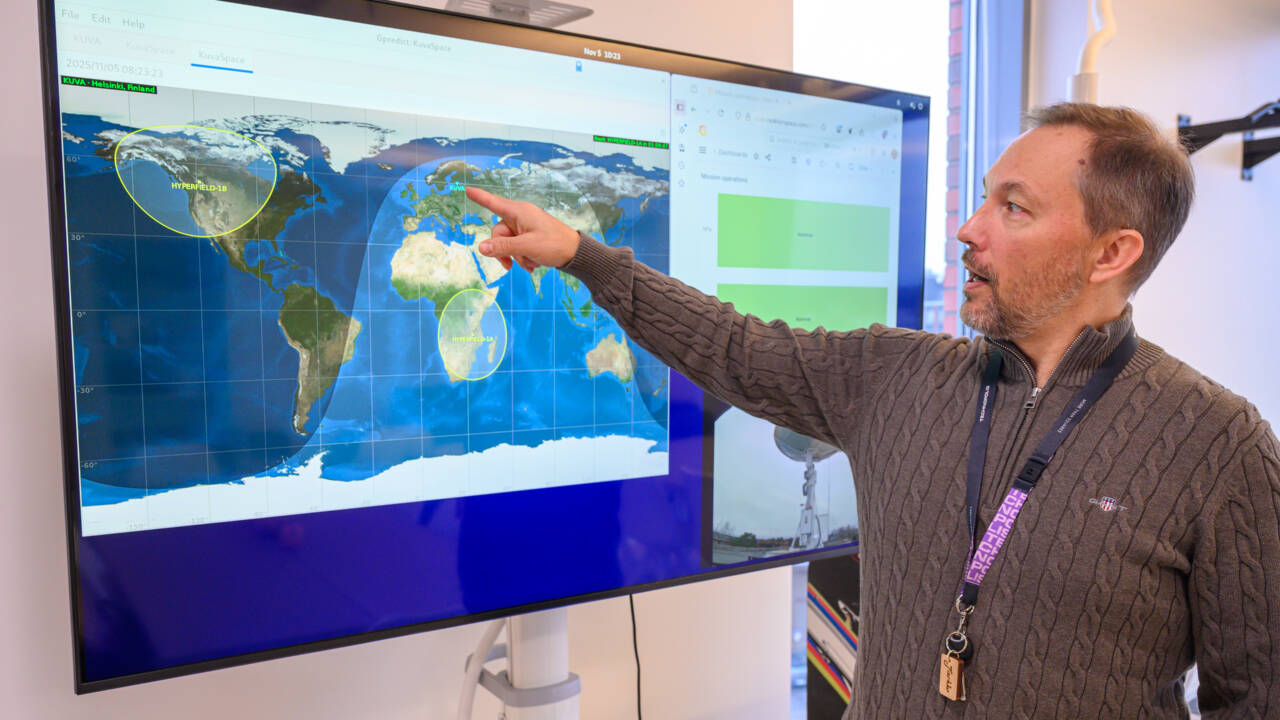
Daily global data from Kuva Space’s satellites
Kuva Space captures rapidly updated Earth observation data through its microsatellites. While the information is increasingly vital for global security, it is also used to monitor climate change, forecast crop yields, analyse water quality, and support land-use planning.