Daily global data from Kuva Space’s satellites
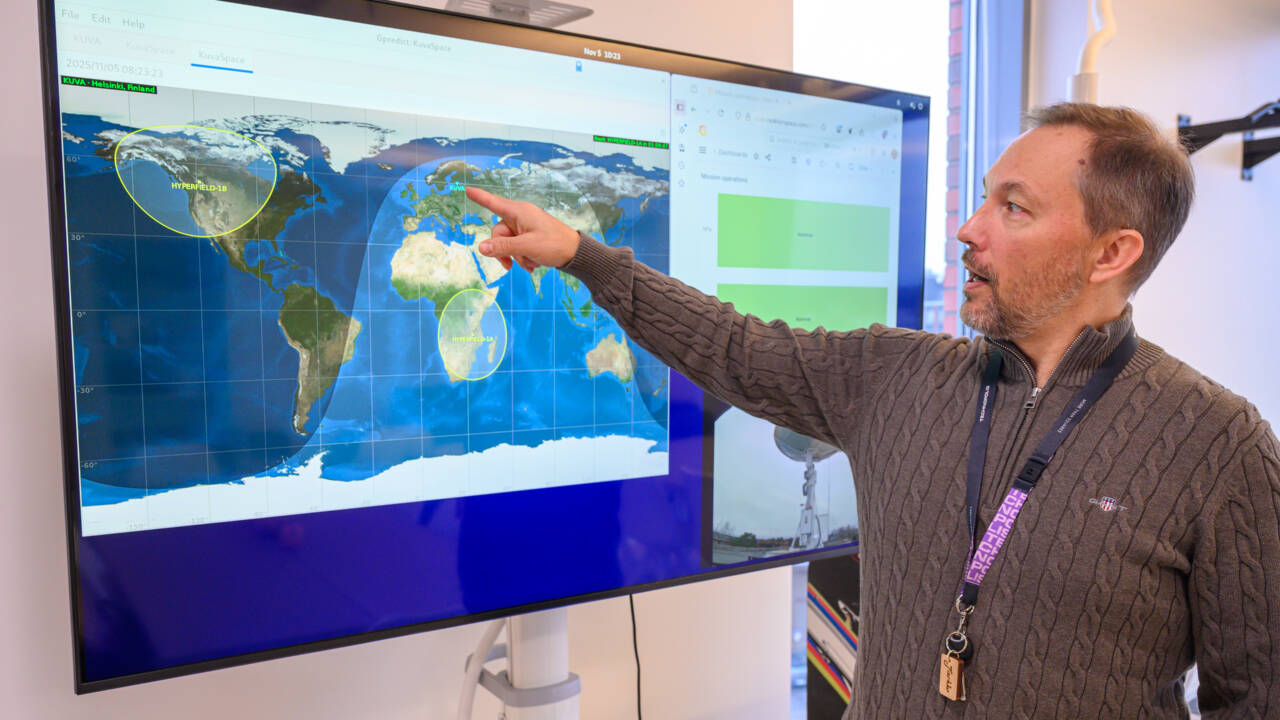
In the bright common areas of Kuva Space’s headquarters in Espoo, a screen tracks the real-time orbit of the company’s satellites. One is currently passing over North America, the other over southern Africa.
When the satellites move across Finland and Kuva Space’s ground station in Otaniemi, the raw data they’ve collected is downloaded. From there, artificial intelligence takes over, analysing the massive data streams.
Clients receive continuously updated information — essential for monitoring carbon sequestration, predicting harvests, studying marine water quality, and increasingly, assessing security situations around the world.
A strategic shift
When Aalto University space technology students Tuomas Tikka and Janne Kuhno founded the company in 2016, the strategy was far from fixed. Would they focus on communications satellites — or even space mining?
As camera technologies advanced, Kuva Space shifted direction and became a digital services company using its own satellites as a proprietary data source.
The company launched its first commercial hyperspectral microsatellite in August 2024, but even before that, Kuva Space became the first Finnish company to deliver a satellite mission to the European Space Agency (ESA).
Building the satellites in-house
Kuva Space manufactures its satellites at Technopolis in Espoo. CEO Jarkko Antila leads the tour. From the sixth floor, there’s a clear view toward Otaniemi — home to another major Finnish space technology company, Iceye.
Antila says that although the two companies operate within the same sector and both image the Earth, they are not direct competitors. Their satellites “see” different things and are used differently.
Iceye’s radar satellites capture shapes and structures, while Kuva Space’s hyperspectral cameras analyse material composition. Kuva Space also covers wider areas in a single pass.
– Our goal is to image the entire planet daily by 2028, Antila says.
According to him, Kuva Space currently has few direct competitors — companies that both manufacture their own satellites, use hyperspectral imaging, and analyse the resulting data. Even so, securing funding has sometimes been difficult since the company is creating an entirely new market. Challenges persisted even after Kuva Space won NATO’s Arctic Challenge innovation competition a couple of years ago.
Our goal is to image the entire planet daily by 2028.
Next-generation satellites deliver higher precision
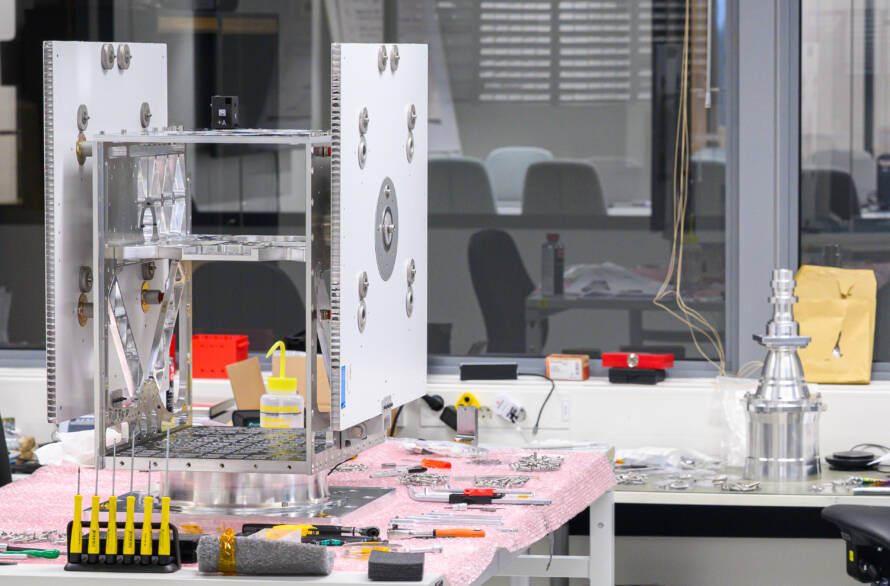
Antila shows a workstation where a new satellite is being assembled and its software tested. From here, the satellites already in orbit can also be remotely controlled.
We see mechanical test models and a miniature 3D-printed version of the next-generation satellite. The small model demonstrates how the satellite expands dramatically when its solar panels unfold in space.
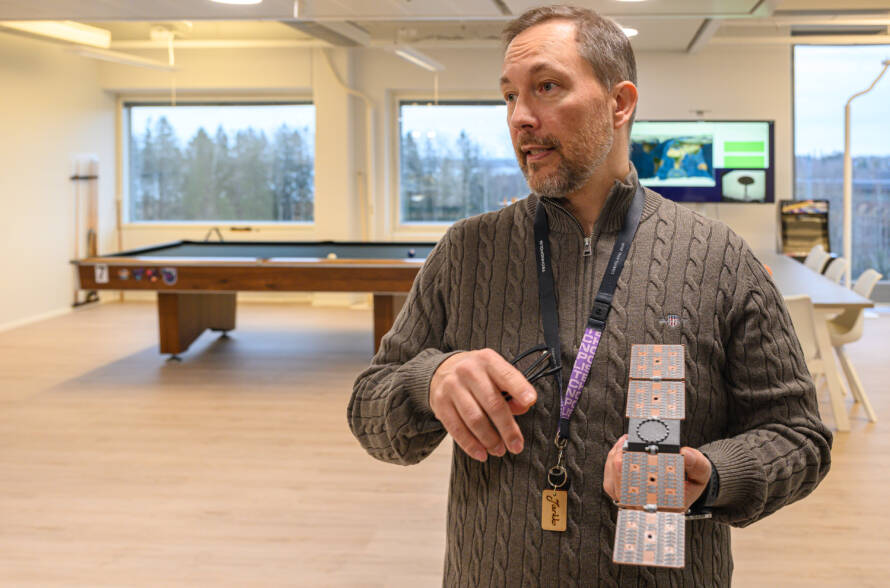
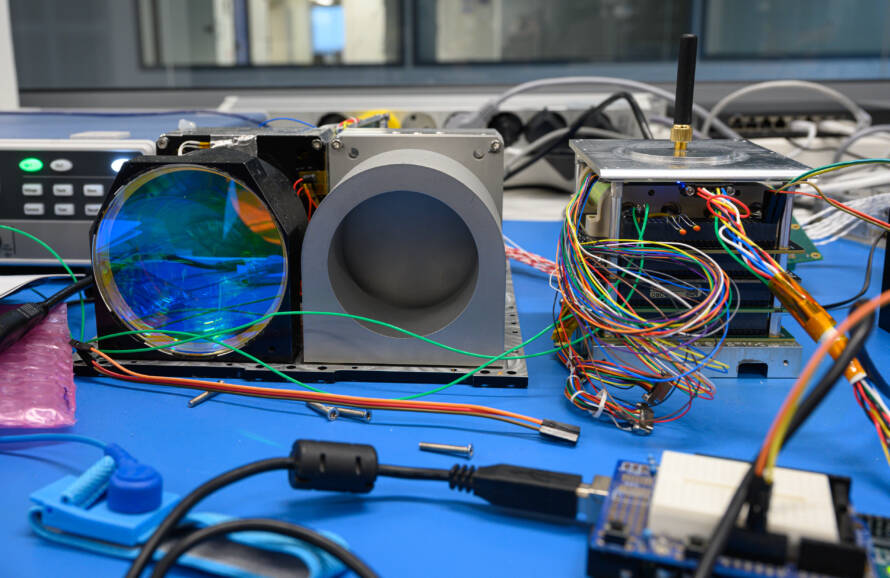
The first two next-generation satellites are scheduled for launch in 2026. They will carry four cameras instead of the current two and include infrared capability, enabling even more precise material identification.
In the adjoining cleanroom — viewed from a restricted entry area — satellite testing is underway. Each satellite must pass vibration and shock tests before launch.
Access to the darkest and cleanest room is limited to only a few specialists, who wear full protective suits. That is where the camera sensors are calibrated.
AI to handle massive data volumes
For now, Kuva Space operates a single ground station, but more are planned around the world as the satellite constellation expands. By 2030, the company expects to operate one hundred microsatellites — enough to image the planet several times a day and provide near-real-time insights.
Demand for this data is strong, and as Antila puts it, Kuva Space is already collecting a huge amount of information. Recent growth has come especially from the security and defence sector, and ESA remains a long-standing client.
Artificial intelligence is essential for processing the massive volumes of hyperspectral data and optimising satellite performance.
– The goal is to automate as much of the pipeline as possible and build systems accordingly, Antila says.
Kuva Space’s expertise in AI has been widely recognised. At Finland’s national AI awards, AI Finland named three leading AI innovators — Kuva Space, Orion Cube, and Trueflaw.
A growing ecosystem in need of talent
Kuva Space now employs 45 people, with 35 in Finland and the rest across Europe, the United States, and Japan. Recruiting talent has been manageable, Antila says, although true space-technology experts are rare. In Finland, most are trained at Aalto University.
Some employees have even relocated from abroad despite the option to work remotely.
Antila hopes funding for education will grow, as Finland’s space ecosystem is expanding rapidly.
– People are fascinated by space — and by the possibility of making Earth a better place to live, he says.
Kuva Space aims to become a global market leader in its field and the world’s best source of environmental and security intelligence.
Could the company be acquired before it reaches that point? Antila says it’s possible. But equally possible is that Kuva Space eventually lists on the stock market, opening ownership to ordinary investors.
Cases

Innovative Helsinki-Uusimaa
The Helsinki-Uusimaa Region is one of the most innovative regions in Europe and the most dynamic region in Finland.
Take also a look at these
 News
News
8.10.2026
Over billion euros in Horizon Europe funding secured for Helsinki-Uusimaa
Organisations in the Helsinki-Uusimaa region have so far received around 1.07 billion euros from the European Union's Horizon Europe programme for research, development and innovation (RDI) activities. This is more than 60 per cent of all the funding Finland has received during the EU's current programme period of 2021–2027.
 Cases
Cases
7.10.2026
Future traffic in the Baltic Sea and urban airspace
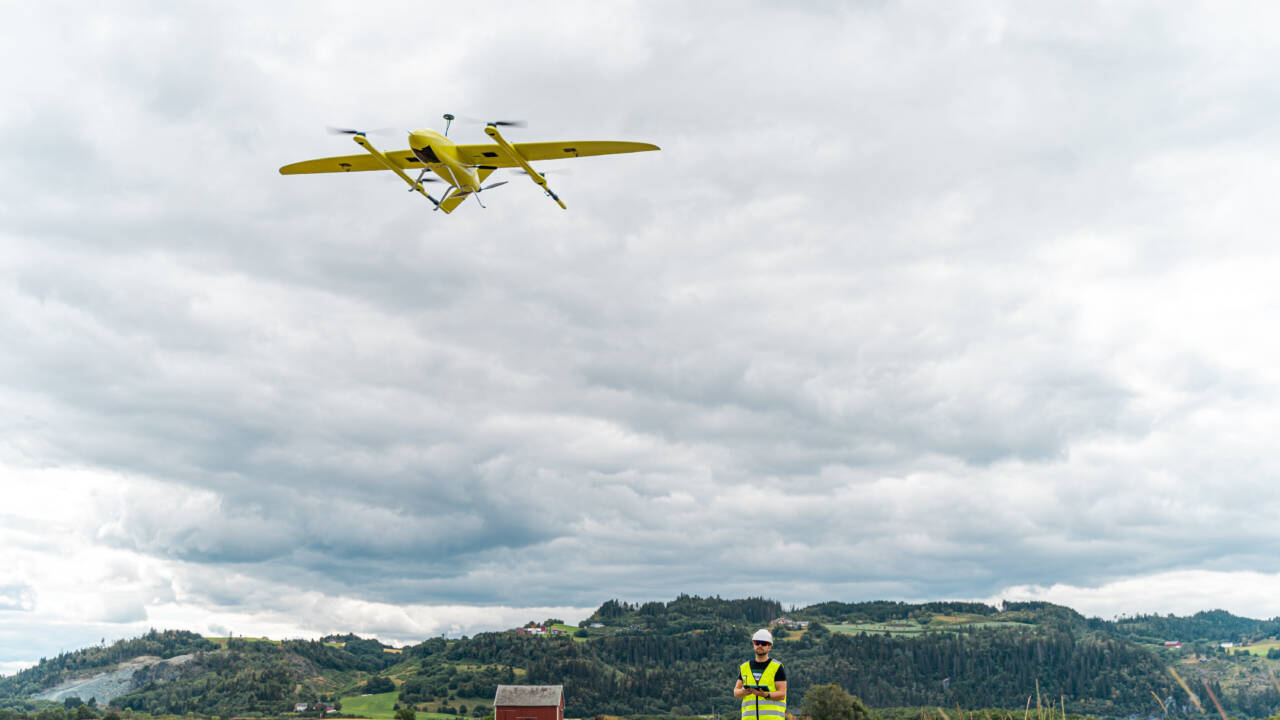
Safe navigation in the waters and air of the Baltic Sea region is increasingly dependent on up-to-date information, functioning backup systems, and foresight. In projects under the Interreg Baltic Sea Region programme, Finnish operators have developed solutions that improve navigation and preparedness for disruptions, and help cities to prepare for the proliferation of drones.